

Visual Aura: Migraine, or Something Else?
29 October 2026
Steroids and Your Eyes: Why Monitoring Matters
29 October 2026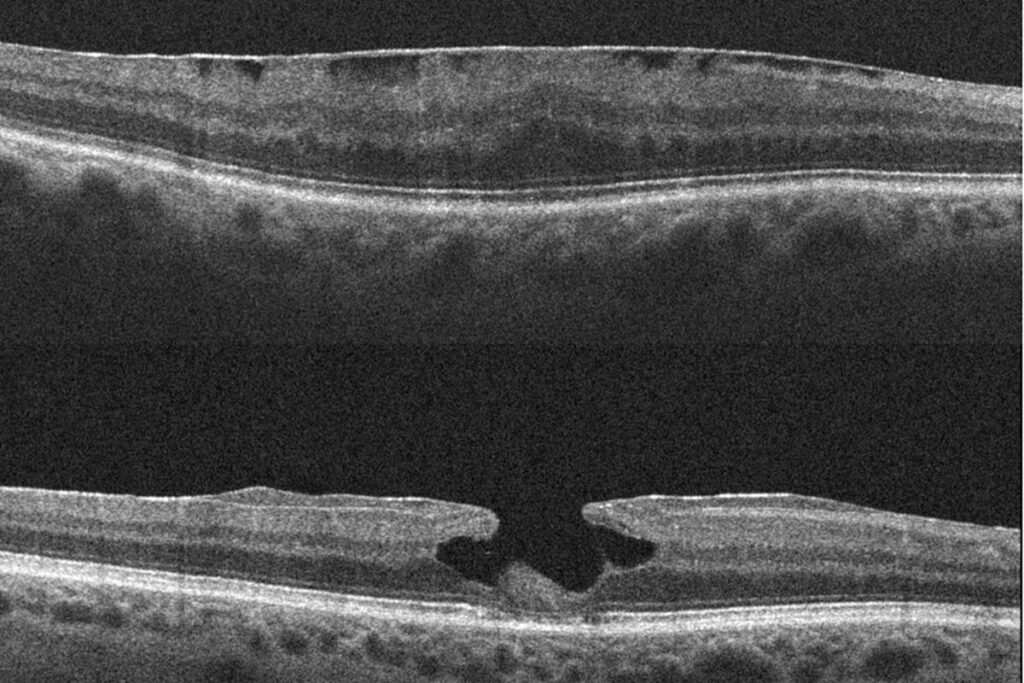
NOVEMBER 2026 · ARTICLE 03 OF 04 · DIAGNOSE
Epiretinal Membrane: When a Fine Film Distorts Central Vision
DR JOHANN SNYMAN · OPHTHALMOLOGIST · KLOOF & WESTVILLE · 4 MIN READ
Straight lines are supposed to look straight.
When the edge of a door, a line of text or a window frame begins to look bent or crumpled in one eye, the problem may be coming from the macula, the small central part of the retina responsible for fine detail.
One possible cause is an epiretinal membrane, also called a macular pucker.
An epiretinal membrane is a very thin layer of tissue that develops on the surface of the macula. If it contracts, it can gently wrinkle or distort the retina beneath it.
Sometimes the retina is not blurred because it cannot focus. It is blurred because its surface has been physically distorted.
Why an Epiretinal Membrane Develops
In many cases, an epiretinal membrane develops as part of age-related changes in the vitreous gel inside the eye.
As the vitreous gradually separates from the retina, microscopic changes at the retinal surface can stimulate formation of a membrane.
It can also develop after retinal disease, inflammation, an eye injury, retinal surgery or other conditions, although many cases occur without a single identifiable trigger.
Most develop gradually rather than suddenly.
What Patients Notice
Mild epiretinal membranes may cause very little difficulty and can be discovered incidentally during an examination.
When symptoms develop, vision may become blurred or distorted. Printed lines may appear wavy, letters may look compressed, or objects can appear slightly different in size between the two eyes.
Some patients describe a form of double or ghosted vision that remains even when the other eye is covered.
These symptoms can resemble macular degeneration and other retinal conditions, so the symptom alone cannot establish the diagnosis.
Why OCT Is So Useful
An OCT scan provides a cross-sectional image of the macula and can show the membrane lying across the retinal surface.
It also reveals how much the underlying macular architecture has been altered and whether there is associated swelling, traction or another retinal condition.
OCT is particularly valuable when vision changes are relatively subtle because the membrane may be difficult for a patient to understand simply from a description of what was seen during the examination.
The scan turns that change into something that can be seen, measured and compared over time.
Does Every Membrane Need Surgery?
No.
Many epiretinal membranes are mild and can simply be monitored. Treatment decisions are guided less by the fact that a membrane exists and more by how much it affects the person’s useful vision.
If distortion or loss of central detail begins to interfere significantly with reading, driving, work or other daily activities, retinal surgery may be considered.
The procedure generally involves vitrectomy followed by careful peeling of the membrane from the retinal surface.
Surgery has potential benefits and potential risks, and visual improvement is not instantaneous or guaranteed. The decision is therefore individual and should reflect symptoms, OCT findings, general eye health and how much the condition affects quality of life.
Sudden Distortion Is Different
An epiretinal membrane usually changes gradually.
New distortion that appears suddenly should be assessed promptly because wet macular degeneration, retinal vascular disease and other conditions can also cause straight lines to become wavy.
When Straight Lines Bend, Look at the Macula.
A new glasses prescription cannot correct every form of distortion. Sometimes understanding the retina itself is the key to understanding why the world no longer looks quite straight.
Medical information cross-checked against National Eye Institute and current ophthalmology references on epiretinal membrane/macular pucker diagnosis and management.
Related reading
If you have concerns about your eyes, Dr Johann Snyman’s Kloof and Westville rooms are here to help.